Chapter 5
Cultural Destruction
How Muhammad Ghori's conquests erased millennia of art, scholarship, language, and civilization.
How Muhammad Ghori's conquests erased millennia of art, scholarship, language, and civilization.
To understand the cultural catastrophe of Muhammad Ghori's campaigns, one must begin with Nalanda University — the greatest centre of learning the ancient world had ever produced.
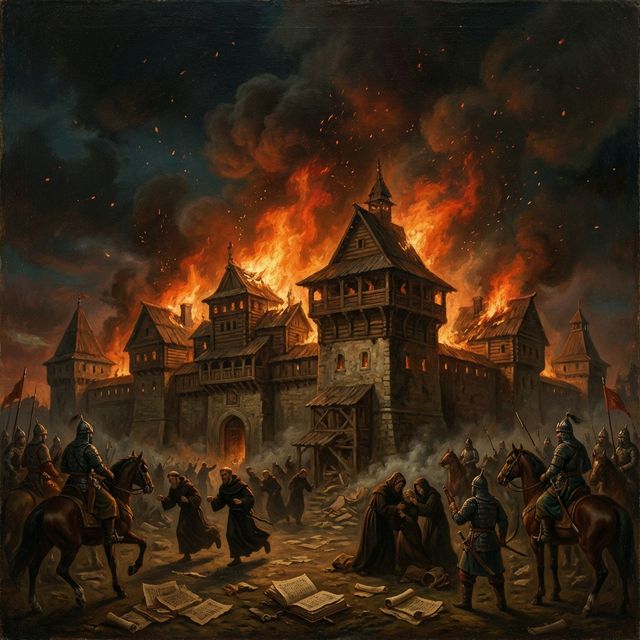
In 1193 CE, Bakhtiyar Khilji — Muhammad Ghori's general who led the Bihar campaign — attacked and burned Nalanda. The primary account comes from Minhaj-i-Siraj Juzjani in the Tabaqat-i-Nasiri (c. 1260 CE):
The scholars who had shaved heads (Buddhist monks) were mistaken for "Brahmin priests" by Khilji's soldiers. They were executed wholesale. The monks who survived fled to Nepal and Tibet — and this is how Tibetan Buddhism preserved much of the Nalanda tradition. Tibetan Buddhist texts today contain knowledge that was lost in India because of this single act of destruction.
Nalanda was not the only target. Bakhtiyar Khilji's Bihar campaign of 1193–1203 CE systematically dismantled India's entire network of Buddhist learning:
Before Ghori's campaigns, India had three world-class universities, tens of thousands of Buddhist monks and scholars, and a living tradition of Buddhist (and Hindu) philosophy going back nearly 1,700 years. Within 50 years of Khilji's campaigns, Buddhism had essentially vanished from the Indian subcontinent. There is no parallel for this level of cultural destruction in any other civilization's history — the deliberate, army-led destruction of an entire intellectual and spiritual tradition at its source.
Beyond the destruction of knowledge, Ghori's campaigns erased an extraordinary tradition of Hindu and Buddhist artistic achievement.
The Quwwat-ul-Islam mosque in Delhi — the first mosque in India — was explicitly built using material from 27 demolished Hindu and Jain temples. This includes not just structural material but carved columns, friezes, and decorative elements.
Visiting the Qutb Minar complex in Delhi today, you can see columns that still bear:
The new builders did not remove or destroy these carvings — they simply repurposed the columns upside-down or sideways, incorporating sacred Hindu imagery into a mosque. This was not an artistic dialogue; it was a statement of dominance.
Sanskrit, the language of India's intellectual tradition — its mathematics, philosophy, law, literature, astronomy, and medicine — was systematically marginalized under the new Persian-Arabic administrative order. Sanskrit learning centres (the gurukul system and formal educational institutions like the Sanskrit college at Ajmer) were either destroyed or lost their patronage and gradually declined.
The long-term impact: India's intellectual output in mathematics, astronomy, and philosophy — which had been world-leading — declined dramatically over the subsequent centuries. The chain of transmission of knowledge from teacher to student, which is how pre-print knowledge survived, was deliberately broken.