Chapter 3
Battles & Invasions
Documented accounts of every major battle and its devastating aftermath for Indian civilization.
Documented accounts of every major battle and its devastating aftermath for Indian civilization.
No event in medieval Indian history is more consequential than the twin Battles of Tarain (1191 and 1192 CE). They represent the pivot point — the moment when India's political sovereignty was irrevocably broken and a new order imposed.
The flat plains of what is now Haryana witnessed two of the most consequential battles in Indian history within a single year of each other.
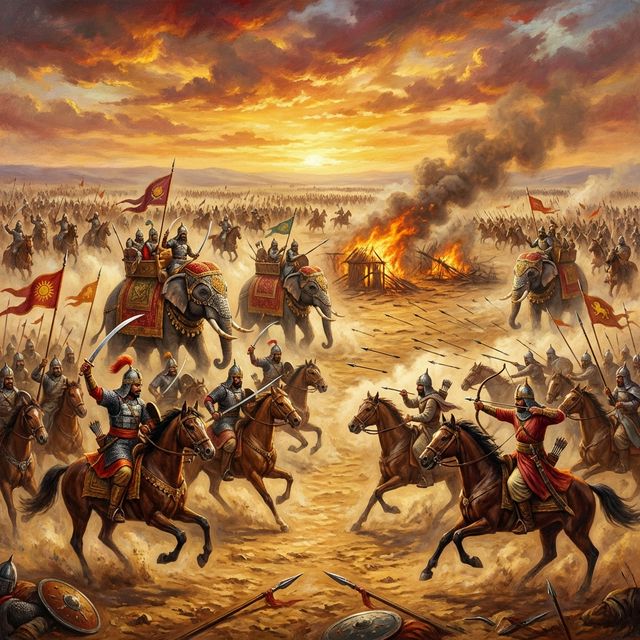
Muhammad Ghori invaded the territories of Prithviraj Chauhan III, the Chahamana (Chauhan) king of Ajmer and Delhi, in 1191 CE. At Tarain, the Rajput coalition — comprising forces from Delhi, Ajmer, and allied kingdoms — met Ghori's forces in open battle.
The battle was a decisive Rajput victory. Ghori was personally wounded by a lance thrown by a Rajput commander, Skanda (or Govinda Rai), and had to be carried from the field. His forces fled in disorder. According to the Prithviraj Raso by Chand Bardai and corroborated by the Tabaqat-i-Nasiri, Ghori was captured and then released by Prithviraj — a decision consistent with the Indian Rajput code of chivalry (dharma of battle) that would prove catastrophic.
Ghori spent the entire year regrouping, restructuring his army, and studying Rajput tactics. He returned with an estimated 120,000 cavalry — significantly larger than his previous force — and a completely different strategy.
Rather than a frontal charge, Ghori used five divisions of cavalry in rotation, launching hit-and-run attacks that exhausted the Rajput forces over hours before the main assault. According to the Taj-ul-Maasir, Prithviraj's forces numbered 300,000 (likely an exaggeration, but indicative of a large army). The Ghurid feigned retreat tactics proved devastating against the traditional Rajput massed formation.
Prithviraj III was captured in flight. He was blinded and then executed, ending the Chauhan dynasty. His brother Hamir continued resistance, but the battle had effectively ended organized Hindu opposition in the region.
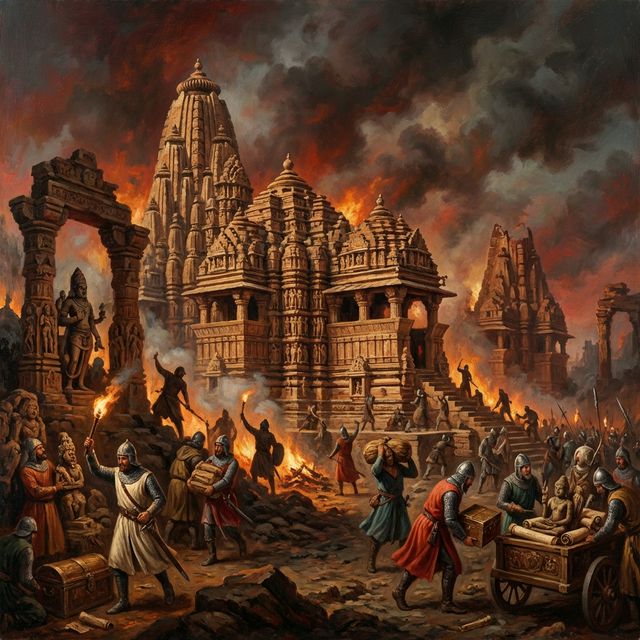
Within months of the battle: Delhi was occupied, the Hindu administration dismantled, and the Quwwat-ul-Islam mosque ordered (built on 27 demolished temples). Ajmer was captured, the Sanskrit college destroyed, and the Dhai Din Ka Jhonpra mosque built on its ruins. The pattern of replacing sacred Hindu and Buddhist sites with mosques was established immediately and continued for centuries.
Two years after Tarain, Ghori personally led an army into the Doab (the area between the Ganges and Yamuna rivers). At Chandawar (near Firozabad, Uttar Pradesh), he faced Jayachandra of Kannauj — king of the Gahadavala dynasty and one of the last major independent Hindu rulers of the Gangetic plain.
Jayachandra was killed in battle. His forces routed, the Ghurid army proceeded to sack Kannauj and then Varanasi (Banaras) — the holiest city in Hinduism and a living university of Sanskrit learning.
Hasan Nizami records in the Taj-ul-Maasir: "A thousand temples of Banaras were emptied of their idols, and mosques were built in their places." The city's population was either killed or enslaved.
Documented across the primary chronicles, the following cities were specifically targeted and sacked during Muhammad Ghori's campaigns and those of his immediate generals: