Chapter 4
Religious Persecution
The documented pattern of ideological destruction — forced conversions, mass enslavement, and the deliberate erasure of Hindu and Buddhist religious identity.
The documented pattern of ideological destruction — forced conversions, mass enslavement, and the deliberate erasure of Hindu and Buddhist religious identity.
Medieval warfare was common across the world. What distinguished Muhammad Ghori's campaigns from ordinary military conquest was their explicitly ideological character — the deliberate targeting of religious sites, scriptures, scholars, and communities not merely as collateral damage, but as the primary objective.
This is not a modern interpretation. It is how Ghori's own court historians described his campaigns — as jihad, as the spreading of the "true faith," as the destruction of "infidel" worship. The Taj-ul-Maasir by Hasan Nizami — Ghori's contemporary court historian — celebrates each temple destruction as a religious achievement.
Understanding this context is essential to understanding why it happened (not just that it happened) and why it is historically dishonest to describe these campaigns as merely "political conflicts."
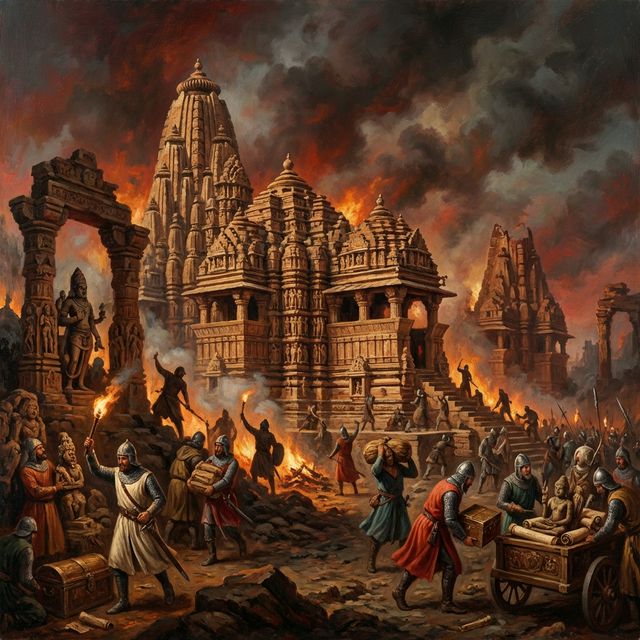
The destruction of Hindu and Buddhist temples was not incidental to Ghori's campaigns — it was a core policy objective, documented as such by his court historians.
The available evidence suggests the following pattern across all of Ghori's campaigns and those of his immediate generals:
Unlike much ancient history, the destruction wrought under Ghori's campaigns has left physical evidence that every Indian can visit:
Every major city captured during Ghori's campaigns — and those of his subsequent generals — was followed by the mass enslavement of the surviving population. This was not incidental looting but a systematic feature of the campaigns.
Historian K.S. Lal in Muslim Slave System in Medieval India (1994) estimates that during the period of the Ghurid invasion and the subsequent Delhi Sultanate, hundreds of thousands of Hindus were enslaved and transported to Central Asian markets. The Tabaqat-i-Nasiri records specific instances of mass captivity after every major battle.
Historian K.S. Lal documented that the slave market established under Ghori's campaigns grew enormously under the subsequent Delhi Sultanate. Hundreds of thousands of enslaved Hindus were used in construction projects, agriculture, and domestic service — their free labor financing the monuments (including the Qutb complex) that UNESCO today designates as "World Heritage Sites."
The monuments of medieval Indo-Islamic architecture were built with resources looted from destroyed Hindu and Buddhist institutions, constructed using materials from demolished temples, and in many cases built by enslaved Hindu craftsmen who were forced to transform their own sacred art into the architecture of a conquering culture.
The pattern of forced or coerced conversion to Islam was systematically employed across Ghori's territory. While individual-level documentation is difficult across centuries, the macro-demographic evidence is compelling:
Historian Will Durant in The Story of Civilization: Our Oriental Heritage (1935) wrote: "The Mohammedan conquest of India is probably the bloodiest story in history. It is a discouraging tale, for its evident moral is that civilization is a precarious thing, whose delicate complex of achievements can at any time be overthrown."
Perhaps the most significant long-term consequence of Ghori's persecution was the complete elimination of Buddhism from the land of its birth. Buddhism in India — which had survived for 1,700 years, produced Nalanda, Vikramashila, and the Ajanta-Ellora traditions — was effectively extinguished within decades of Ghori's campaigns through the destruction of its monasteries, universities, and the massacre of its monks. By the 14th century, Buddhism had essentially vanished from India. This is arguably the greatest act of cultural genocide in human history taking place on Indian soil.