Chapter 1
The Official Narrative
What your textbooks say about Muhammad Ghori — and what they deliberately leave out.
What your textbooks say about Muhammad Ghori — and what they deliberately leave out.
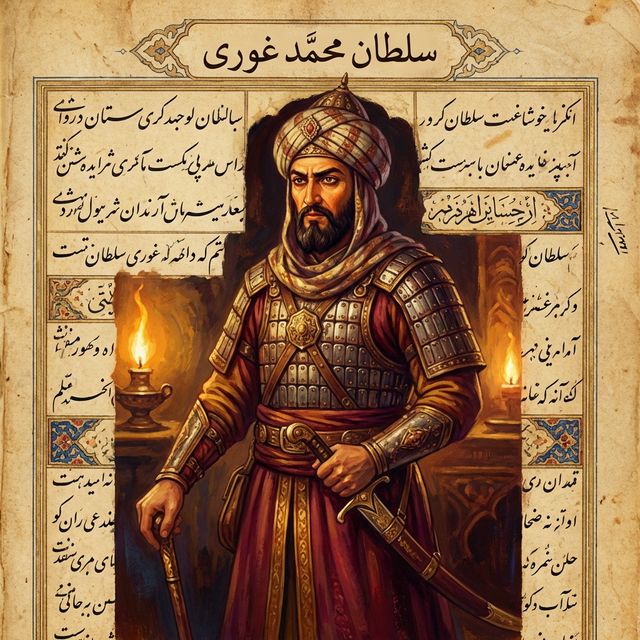
Open any NCERT or state-board history textbook in India, and you will find Muhammad Ghori described in characteristically neutral terms. He is typically presented as the ruler who "established the Delhi Sultanate" and whose general Qutb-ud-din Aibak was a "great administrator." His battles with Prithviraj Chauhan are taught as military conflicts between rival kingdoms.
This is not entirely false. But it is catastrophically incomplete.
What textbooks omit is the documented reality: that Ghori's campaigns were systematic operations of plunder, temple destruction, mass enslavement, and the deliberate annihilation of India's greatest centres of learning — and that the "Delhi Sultanate" was built entirely on the ruins of a civilization he intentionally destroyed.
The typical Indian school textbook presents Muhammad Ghori with the following framing:
Notice what is missing: the Nalanda massacre, the destruction of 27 temples to build mosques, the enslavement of hundreds of thousands, the burning of Buddhist monasteries. The textbook version covers the who and the when but systematically omits the what was destroyed.
After his defeat at the Second Battle of Tarain (1192 CE), Prithviraj Chauhan was captured. According to the Taj-ul-Maasir and Tabaqat-i-Nasiri, he was blinded and then executed — ending a dynasty that had protected northern India. Textbooks present the battle result neutrally, but omit that this was the final defeat of unified Hindu political sovereignty in northern India — a rupture from which it took 300+ years to recover.
Muhammad Ghori's general Bakhtiyar Khilji systematically looted and burned Nalanda University — the world's oldest university (est. ~5th century CE). It housed up to 10,000 students and thousands of teachers at its peak. The Dharmaganja ("Treasury of Truth") library complex held an estimated 9 million manuscripts. Minhaj-i-Siraj's Tabaqat-i-Nasiri records that the smoke burned for three months. The Buddhist monks who survived fled to Nepal and Tibet, effectively ending Buddhism as a living tradition in India.
The Quwwat-ul-Islam mosque in Delhi — the first mosque built in India — was deliberately constructed using material from 27 demolished Hindu and Jain temples. This is not disputed: the mosque's own inscriptions and the chronicle Taj-ul-Maasir document it explicitly. You can visit the site today and see the pillars with their original Hindu carvings still visible.
In Ajmer, Ghori ordered the destruction of a Sanskrit college (Saraswati Kantha Abharana) and had the Dhai Din Ka Jhonpra mosque built on its ruins within 60 hours. The mosque still stands. Hasan Nizami's Taj-ul-Maasir records: "The Sultan gave orders that all the temples should be burnt with naphtha and fire."
After every major city was sacked, the surviving population was enslaved. Hasan Nizami records that after the sack of Varanasi (Banaras), the city's population was either killed or enslaved. Hundreds of thousands of Hindus and Buddhists were transported to Central Asian slave markets — a documented pattern across all of Ghori's campaigns.
Beyond Nalanda, Bakhtiyar Khilji also destroyed Vikramashila University (est. c. 8th century CE) and Odantapuri University in modern Bihar — effectively dismantling the entire educational and religious infrastructure of eastern India in a single campaign. Thousands of monks were slaughtered; their shaved heads led Khilji's soldiers to mistake them for soldiers.
The systematic minimization of Muhammad Ghori's atrocities in Indian textbooks is not accidental — it is part of a broader pattern of historiographical bias documented by scholars like Arun Shourie in Eminent Historians and Sita Ram Goel in Hindu Temples: What Happened to Them.
This whitewashing operates through several mechanisms:
The whitewashing of Muhammad Ghori's atrocities is not just a historical curiosity — it has real consequences for how Indians understand their own civilization.
When textbooks present the destruction of Nalanda as a "minor event" or omit it entirely, they deny future generations the ability to understand why Buddhist learning vanished from India, why certain temple sites remain contested today, and why the intellectual trajectory of the subcontinent was fundamentally altered.
The Quwwat-ul-Islam mosque — built on 27 demolished temples — still stands in Delhi's Qutb Minar complex, a UNESCO World Heritage Site. Millions of Indians visit it every year without knowing that the decorative pillars they admire were carved by Hindu artisans for Hindu temples that were demolished to build this mosque.
Historical literacy is not about fostering resentment — it is about building informed citizens who understand the forces that shaped their civilization.