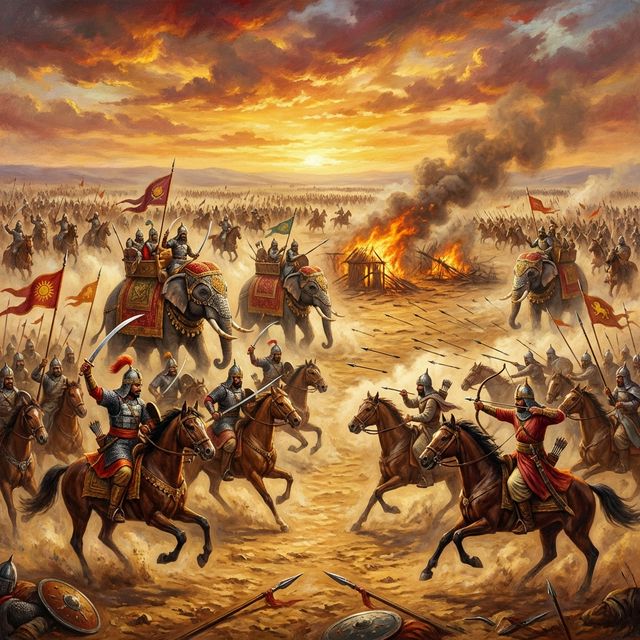
Seven Campaigns of Conquest

Muhammad Ghori (Mu'izz ad-Din Muhammad ibn Sам, also known as Shahab-ud-Din Muhammad Ghori) conducted at least seven major campaigns into the Indian subcontinent between 1175 CE and 1206 CE. Each campaign was larger than the last, systematically dismantling India's political sovereignty and replacing its civilization with a new order.

Unlike Mahmud of Ghazni, who raided and retreated, Ghori came to stay. His invasions were aimed at permanent conquest — the transformation of Hindustan into a new province of an Islamic empire. He succeeded in his political goals, but at a cost to Indian civilization that scholars are still measuring today.

Sources: Taj-ul-Maasir (Hasan Nizami), Tabaqat-i-Nasiri (Minhaj-i-Siraj), Tarikh-i-Ferishta (Ferishta), and R.C. Majumdar's History and Culture of the Indian People.

1175 CE
First Invasion: Multan and Uch
Muhammad Ghori's first Indian campaign targets Multan (in modern Pakistan) and Uch. He captures both cities after brief resistance. This campaign established a bridgehead for future deeper invasions. Churches, temples, and the local governing structure were dismantled and replaced.

Source: Tabaqat-i-Nasiri, Minhaj-i-Siraj (c. 1260 CE)
1178 CE
Defeat at Gujarat — Battle of Mount Abu
Ghori's forces suffer their only major defeat in India at the Battle of Kasahrada, near Mount Abu, at the hands of the Chaulukya (Solanki) king Mularaja II of Gujarat. The defeat was significant enough to temporarily check Ghori's westward expansion, but he redirected his forces northward and returned with greater determination.

Source: Tarikh-i-Ferishta (Ferishta, c. 1612 CE)
1179–1186 CE
Punjab Campaigns — Lahore and Sirhind Captured
In a series of campaigns, Ghori captures Peshawar (1179), Lahore (1186), and Sirhind. The Ghaznavid dynasty which had controlled Punjab was finally extinguished. Lahore's temples were destroyed and replaced with mosques. This gave Ghori control of the entire northwestern corridor into the Gangetic plain.

Source: Taj-ul-Maasir (Hasan Nizami, c. 1228 CE); R.C. Majumdar, History and Culture of the Indian People Vol. 5
1191 CE
First Battle of Tarain — Ghori Defeated
At Tarain (modern Taraori, Haryana), Prithviraj Chauhan's Rajput coalition inflicts a decisive defeat on Ghori. Ghori himself is wounded and nearly killed. His forces flee in disorder. The victory was celebrated across Rajputana. Prithviraj, following the Indian tradition of chivalry, released Ghori after his capture.

This act of mercy — releasing a captured enemy — would prove to be a fatal mistake.

Source: Prithviraj Raso (Chand Bardai); Tabaqat-i-Nasiri (Minhaj-i-Siraj)
1192 CE
⚡ Second Battle of Tarain — India's Sovereignty Broken
Ghori returns with a restructured army of 120,000 cavalry. Using night raids, feigned retreats, and superior cavalry tactics, his forces rout the Rajput army of an estimated 300,000 soldiers (per medieval chronicles). Prithviraj Chauhan is captured and later blinded and executed.

This single battle ended 5,000+ years of continuous Hindu political sovereignty in northern India. Within a year, Delhi, Ajmer, and the Gangetic plain were under Ghurid control.

The mosques built on demolished temple sites in Delhi and Ajmer still stand today.

Source: Taj-ul-Maasir (Hasan Nizami); Tabaqat-i-Nasiri (Minhaj-i-Siraj)
1193 CE
🔥 Nalanda Burned — Greatest Crime Against Knowledge
Bakhtiyar Khilji, Ghori's general, campaigns into Bihar. He sacks and burns Nalanda University — the world's oldest university with 10,000 students and an estimated 9 million manuscripts. The burning continues for three months. Vikramashila and Odantapuri universities are also destroyed.

Thousands of Buddhist monks are killed. Buddhism as a living practice in India effectively ends. Survivors flee to Nepal and Tibet, taking whatever knowledge they could carry.

Source: Tabaqat-i-Nasiri (Minhaj-i-Siraj, c. 1260 CE)
1194 CE
Battle of Chandawar — Kannauj and Varanasi Sacked
Ghori personally leads a campaign into the Gangetic plain. At the Battle of Chandawar (near Firozabad), he defeats the Gahadavala king Jayachandra of Kannauj. After the victory, Varanasi (Banaras) — the holiest city in Hinduism — is sacked. The Taj-ul-Maasir records a thousand temples destroyed and replaced with mosques. Libraries and temples in Kannauj are also dismantled.

Source: Taj-ul-Maasir (Hasan Nizami)
1195–1203 CE
Consolidation — Gwalior, Anhilwara, and Beyond
Through his generals (chiefly Qutb-ud-din Aibak and Bakhtiyar Khilji), Ghori systematically extends conquest across the subcontinent. Gwalior fort is captured (1196). Bengal campaigns begin (1203), reaching as far east as Nadia, capital of the Sena dynasty. The entire Gangetic plain — from Punjab to Bengal — comes under Ghurid control within a decade of the Second Battle of Tarain.

Source: Tabaqat-i-Nasiri (Minhaj-i-Siraj)
1206 CE
Muhammad Ghori Assassinated — The Sultanate Begins
While returning from a campaign suppressing a revolt in the Punjab, Muhammad Ghori is assassinated on March 15, 1206, near Jhelum (in modern Pakistan). The assassins are variously attributed to Hindu Khokhars, or by some accounts, Ismaili Shias.

He dies without a son. His trusted slave-general Qutb-ud-din Aibak declares himself the first Sultan of Delhi — founding the Slave Dynasty and beginning 317 years of the Delhi Sultanate, built entirely on the foundation of destruction Ghori created.

Source: Tabaqat-i-Nasiri (Minhaj-i-Siraj)

The Legacy of the Timeline

⚠️ What 31 Years of Conquest Did to India
  • Ended continuous Hindu political sovereignty in northern India (5,000+ year tradition)
  • Destroyed Nalanda, Vikramashila, and Odantapuri universities — erasing millennia of knowledge
  • Ended Buddhism as a living religion in India — birthplace of the Buddha
  • Established the Delhi Sultanate — which would rule under various dynasties for the next 320 years
  • Created the architectural precedent of building on demolished temple sites, continued by all subsequent sultans
  • Set the pattern for mass enslavement of Indian populations that continued under the Sultanate
Next Chapter

Battles & Invasions Documented →

Detailed accounts of the key battles and their aftermath for Indian civilization.