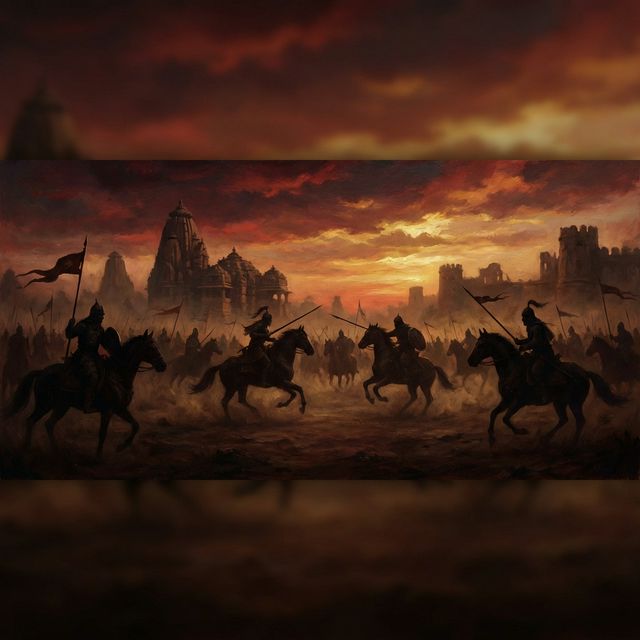
Wide panoramic depiction of medieval Indian battlefield circa 1192 CE — silhouettes of soldiers on horseback against a dramatic crimson and gold sunset sky, ancient temple ruins visible in the distance, atmospheric battlefield haze representing the conquest of India by Muhammad Ghori and the fall of Hindu kingdoms

Muhammad Ghori The Conqueror Who Shattered India's Sovereignty

What your textbooks never fully taught you. A comprehensive, source-backed chronicle of the Ghurid invasions of India, the defeat of Prithviraj Chauhan, the destruction of Nalanda, mass persecution, and how Muhammad Ghori's legacy permanently altered India's civilizational trajectory — and why it still matters today.

Scroll to explore
📊 The Scale of Destruction

The Numbers They Don't Teach

Documented by medieval historians, archaeological surveys, and primary chronicles — the staggering scale of Muhammad Ghori's systematic destruction of India's civilization.

⚔️
0
Major Invasions of India
1175–1206 CE — documented across multiple chronicles
🏛️
0
Temples Destroyed or Converted
Per Hasan Nizami's Taj-ul-Maasir & archaeological records
💰
0
Estimated Loot (2024 Values)
Gold, jewels, and wealth extracted from Indian temples & cities
📚
0
Books Burned at Nalanda
World's oldest university — burned for 3 months (1193 CE)
🧭 Your Journey Through History

What This Encyclopedia Covers

Navigate through each chapter to uncover the layers of truth that have been systematically hidden, whitewashed, or overlooked in mainstream education.

📖
The sanitized textbook narrative vs. documented reality
Chapter 1

The Official Narrative

How Indian textbooks have portrayed Muhammad Ghori as a "founder of the Delhi Sultanate" while systematically omitting his documented plunder, destruction, and mass persecution.

Uncover the truth
📅
7 invasions of documented destruction, year by year
Chapter 2

Timeline of Invasions

An interactive, chronological walk through every major invasion during Muhammad Ghori's campaigns — from 1175 CE to his assassination in 1206 CE.

Walk through time
⚔️
Tarain, Chandawar — battles that changed India forever
Chapter 3

Battles & Invasions

Detailed accounts of specific battles — the First and Second Battle of Tarain, the Battle of Chandawar, the sacking of Ajmer, Delhi, Varanasi, and more.

See the evidence
⛓️
Systematic religious oppression of Hindu and Buddhist communities
Chapter 4

Religious Persecution

Forced conversions. Mass enslavements. Idol-breaking as state policy. The destruction of Hindu and Buddhist institutions. The full documented record.

Read the accounts
🎭
Nalanda, art, knowledge, and heritage — erased
Chapter 5

Cultural Destruction

Beyond temples — how Ghori's invasions destroyed Nalanda University, libraries, Buddhist monasteries, artistic traditions, and centuries of accumulated knowledge.

Understand the loss
📊
Data visualization of the scale of plunder and destruction
Chapter 6

The Damage Quantified

Numbers, statistics, and data that put the scale of destruction into perspective — wealth looted, temples destroyed, populations enslaved, knowledge lost forever.

See the numbers
🔗
How the past connects to India's present struggles
Chapter 7

Legacy & Modern Impact

How Ghori's conquests echo today — the destruction of Indian sovereignty, the creation of the Delhi Sultanate, and the civilizational wound that hasn't healed.

Connect past to present
📚
Complete bibliography of primary and secondary sources
Chapter 8

Sources & References

Every claim on this site is backed by primary sources — Taj-ul-Maasir, Tabaqat-i-Nasiri, Minhaj-i-Siraj, Ferishta. Explore the complete bibliography with verification links.

Verify the sources
ℹ️
Our mission, methodology, and commitment to truth
About

About This Project

Why this website exists, our methodology for historical research, our commitment to accuracy, and how you can contribute to this educational initiative.

Learn more
The Sultan gave orders that all the temples should be burnt with naphtha and fire, and levelled with the ground... At Ajmer, he saw the temples and ordered their destruction. On the same day he began building the Mosque of 'Two-and-a-half-days' (Dhai Din Ka Jhonpra) on that spot. Taj-ul-Maasir by Hasan Nizami (c. 1228 CE), court historian documenting Muhammad Ghori's campaigns in India
Wikipedia: Taj-ul-Maasir
⚠️ Why This Matters Today

The Dhai Din Ka Jhonpra mosque in Ajmer — built by Muhammad Ghori's general Qutb-ud-din Aibak on the ruins of a Sanskrit college and temple — still stands today as a living monument of this erasure. The Quwwat-ul-Islam mosque in Delhi was built using material from 27 demolished Hindu and Jain temples. These are not ancient controversies — they are physical structures that every Indian can visit and read about. Understanding who built them and why is fundamental to understanding India's civilizational history.

🔍 Textbook vs. Reality

The Two Faces of Muhammad Ghori

One version lives in textbooks. The other is documented in primary historical sources written by medieval chroniclers — many of them his own court historians.

📗
What Textbooks Say
  • "A great military commander who established the Delhi Sultanate"
  • "His battles with Prithviraj Chauhan were political conflicts"
  • "He was a patron of art and culture in Ghazni"
  • "He laid the foundation of Muslim rule in India"
  • "His general Qutb-ud-din Aibak was a great administrator"
  • "An important figure in the history of the Indian subcontinent"
📕
What History Documents
  • Defeated and executed India's last great Hindu emperor Prithviraj Chauhan after his defeat at Second Battle of Tarain (1192 CE)
  • Ordered the complete destruction of Nalanda University (1193 CE) — the world's oldest university, burning its libraries for months
  • Demolished thousands of temples across Ajmer, Delhi, Varanasi, Gwalior, and Kannauj
  • Enslaved hundreds of thousands of Hindus and Buddhists and sold them in Central Asian slave markets
  • Destroyed the Vikramashila and Odantapuri universities, erasing centuries of accumulated knowledge
  • Built mosques on the ruins of 27 demolished temples — creating what his historian called "the conquest of Hindustan"
📚 The Greatest Crime Against Knowledge

The Burning of Nalanda

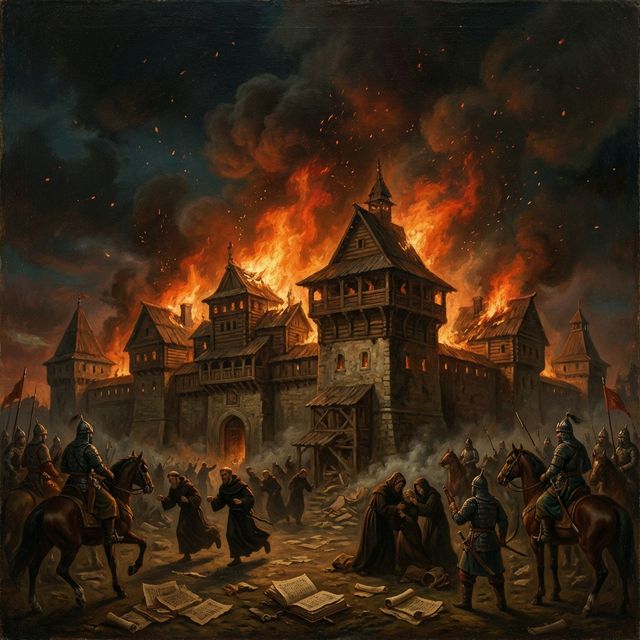
Dramatic historical painting of the burning of Nalanda University in 1193 CE — ancient monastery complex and libraries engulfed in fire and smoke, Buddhist monks fleeing as the world's greatest center of learning is destroyed by Muhammad Ghori's forces under Bakhtiyar Khilji, night sky illuminated by the flames of millions of burning manuscripts

The World's First University — Burned for Three Months

In 1193 CE, Muhammad Ghori's general Bakhtiyar Khilji attacked Nalanda University — the world's oldest residential university, established in the 5th century CE. The library complex, known as Dharmaganja, held an estimated 9 million manuscripts.

When Khilji's soldiers asked local monks what the building was, they were told it was a library. He ordered it burned. According to Minhaj-i-Siraj's Tabaqat-i-Nasiri, "the smoke of burning books darkened the air for three months."

The massacre of thousands of Buddhist monks — who were mistaken for "shaved-headed Brahmin priests" — effectively ended Buddhism in the land of its birth. This single act of cultural genocide had consequences that India still lives with today.

Read Full Account →
🕯️ Education is the First Step

History Forgotten is History Repeated

This website exists because every Indian has the right to know their true history. Every claim is backed by primary historical sources. Every fact is verifiable. Begin your journey through the chapters that textbooks left out.

🌐 Bharat Files Initiative

Explore Sister Projects

Muhammad Ghori is one chapter. The full history of India's subjugation is documented across these comprehensive educational resources — all part of the Bharat Files Initiative.

Early Invasions

Sabuktigin

The Ghaznavid founder who initiated the first raids into India, paving the way for Mahmud's devastating campaigns.

Visit sabuktigin.com
Early Invasions

Mahmud of Ghazni

The Ghaznavid sultan who raided India 17 times, destroyed Somnath, and looted trillions in today's value.

Visit mahmudofghazni.com
Mughal Empire

Aurangzeb Alamgir

The Mughal emperor who reimposed Jizya, destroyed thousands of temples and waged systematic religious war.

Visit aurangezebalamgir.com